
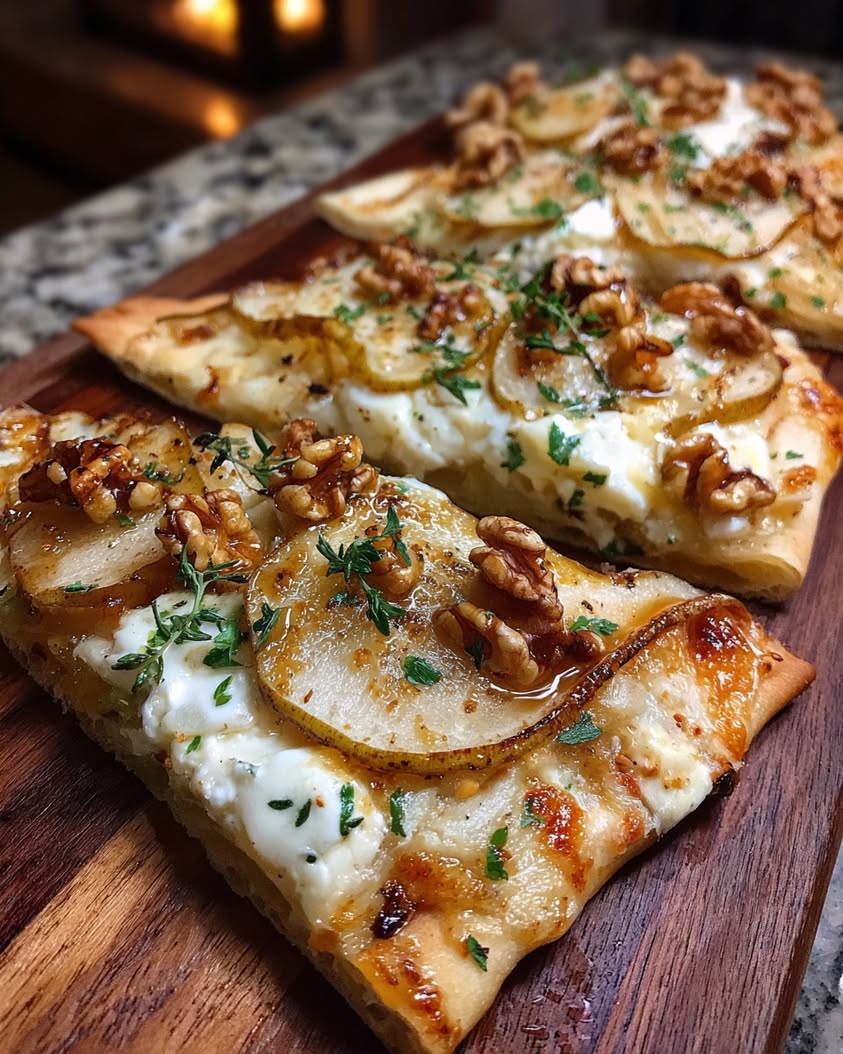
Caramelized Pear Flatbread with Brie, Honey & Toasted Walnuts: A Sweet and Savory Masterpiece
Imagine a crispy, golden flatbread topped with meltingly soft brie, sweet caramelized pears, and a generous drizzle of honey. This caramelized pear flatbread recipe is the ultimate crowd-pleaser, effortlessly blending sweet and savory flavors into one elegant dish. Consequently, it transforms simple ingredients into a gourmet experience that feels special yet is surprisingly simple to make. Whether you need a stunning appetizer for a dinner party or a quick yet impressive weeknight dinner, this flatbread delivers on every level.
The magic of this recipe lies in its beautiful balance. Firstly, the rich, creamy brie provides a luxurious base. Next, the pears cook down with a touch of butter and sugar, developing deep, complex caramel notes that play perfectly against the cheese. Finally, a finish of fragrant honey and crunchy toasted walnuts adds the final layers of texture and flavor. Ultimately, each bite is a harmonious symphony that will have everyone asking for the recipe.
Furthermore, this dish is incredibly versatile. For instance, you can easily adapt it to suit different seasons or dietary needs. Moreover, it comes together in about thirty minutes, making it a perfect solution for last-minute entertaining. In short, this caramelized pear flatbread is a testament to how a few quality ingredients can create something truly extraordinary.
Quick Recipe Highlights
- Flavor Profile: This flatbread masterfully combines sweet and savory elements. The deep caramelized sugar from the pears contrasts with the tangy, rich brie, while the honey adds a floral sweetness that ties everything together.
- Texture: You get a fantastic contrast in every bite. The flatbread base should be crispy and sturdy, supporting the gooey melted brie and tender pears. Meanwhile, the toasted walnuts provide a crucial crunchy element that prevents the dish from feeling too soft.
- Aroma: As it bakes, your kitchen will fill with the warm, comforting scent of melting cheese and cooking fruit. The honey and toasted nuts add a final aromatic layer that is simply irresistible.
- Visual Appeal: This flatbread is a feast for the eyes. The golden crust, white and oozy brie, golden-brown pears, and dark walnuts create a beautiful, rustic presentation that looks professional.
- Skill Level Needed: This is a beginner-friendly recipe. Basic skills like slicing, sautéing, and assembling are all that’s required. Importantly, there’s no complex dough-making or advanced techniques involved.
- Special Equipment: You only need a baking sheet, a skillet for caramelizing, and a sharp knife. A pizza stone or baking steel can elevate the crust but is not at all necessary for success.
Recipe Overview
- Difficulty Level: We rate this recipe as easy. The steps are straightforward and sequential, with no complicated techniques. However, paying attention to the caramelization of the pears is key to maximizing flavor. Overall, even a novice cook can achieve fantastic results.
- Category: This dish brilliantly straddles multiple categories. It functions perfectly as an appetizer or starter for a fancy meal. Additionally, it makes a fantastic light lunch or easy dinner when paired with a simple green salad. Some even enjoy it as a decadent snack.
- Cuisine: While flatbreads have roots in many cultures, this particular combination leans into modern fusion cuisine. It takes inspiration from French cheese boards, Italian pizza bianca, and American gourmet appetizer trends, creating a universally appealing dish.
- Cost: This is a moderately priced recipe. Store-bought flatbread or pizza dough keeps costs down, while brie and fresh pears are the primary investments. Fortunately, a little of each ingredient goes a long way, making it cost-effective for entertaining.
- Season: This recipe shines in the fall when pears are at their peak. However, it’s truly enjoyable year-round. In winter, it feels cozy and rich. Conversely, in summer, it makes a great al fresco dining option.
- Occasion: It’s perfect for casual gatherings, holiday parties, date nights at home, or even a treat-yourself solo meal. Its elegant appearance makes it suitable for formal events, while its ease of preparation makes it ideal for relaxed get-togethers.
Why You’ll Love This Recipe
First and foremost, the taste and texture are utterly captivating. Each component brings something unique to the table, creating a complex eating experience. The initial crisp of the crust gives way to creamy cheese and jammy fruit, followed by the satisfying crunch of nuts. This interplay keeps your palate engaged from the first bite to the last. Furthermore, the combination of sweet honey and savory cheese is a classic for a very good reason—it’s simply delicious.
From a practical standpoint, the convenience is a major win. This caramelized pear flatbread recipe requires minimal active cooking time. You can caramelize the pears while the oven preheats and the flatbread par-bakes. Consequently, the assembly is quick and intuitive. Moreover, it uses mostly pantry staples, meaning you can often whip it up without a special grocery trip. It’s the definition of an impressive yet low-stress dish.
Nutritionally, this dish offers more balance than you might think. Pears provide dietary fiber and vitamin C, while walnuts contribute healthy omega-3 fats and protein. Brie offers calcium and protein, though it should be enjoyed in moderation due to its fat content. When served as a shared appetizer or alongside a large salad, it becomes part of a well-rounded meal.
For social and entertaining value, it’s nearly unbeatable. This flatbread is meant to be shared, torn apart, and enjoyed communally. It serves as a fantastic conversation starter and feels much more special than a bowl of chips. It demonstrates care and effort without requiring you to spend the whole party in the kitchen. Guests always appreciate this kind of homemade, beautiful food.
Finally, it is cost-effective and accessible. Compared to ordering a similar flatbread at a restaurant, making it at home saves significant money. You control the quality of every ingredient. Additionally, the recipe is forgiving and allows for substitutions based on what you have available. This accessibility ensures you can enjoy a gourmet-tasting experience any night of the week.
Historical Background and Cultural Significance
The concept of baking toppings on flatbread is ancient, with roots stretching back thousands of years across numerous cultures. From the simple focaccia of Italy to the flavorful lahmacun of the Middle East, flatbreads have served as a versatile canvas for local ingredients. Our modern interpretation, featuring cheese and fruit, draws heavily from the European tradition of the cheese course and the cheeseboard. Specifically, the pairing of pears and brie is a classic French bistro combination, often served as a dessert or cheese plate finale.
Culturally, combining fruit, cheese, and bread speaks to a rustic, farmhouse style of eating that values seasonal, complementary flavors. This caramelized pear flatbread recipe modernizes that tradition by bringing it into a single, hot, shareable format. It reflects a contemporary dining trend that prioritizes communal plates and bold flavor contrasts. The dish honors its historical roots while feeling entirely current and innovative.
The evolution of this specific recipe is a story of fusion. Pizza and flatbread culture in America embraced gourmet, non-tomato-based toppings in the late 20th century. Chefs began experimenting with ingredients from fine dining and cheese plates. Consequently, combinations like fig and prosciutto or pear and gorgonzola became popular on menus. This recipe is a natural progression, using accessible ingredients to create a similar upscale experience at home. The addition of honey is a nod to ancient sweet-and-savory pairings found in many Mediterranean cuisines.
Regional variations of this concept abound. In the American Pacific Northwest, you might find a version with local hazelnuts and blackberry honey. In Italy, a similar flatbread could feature taleggio cheese and mostarda. The basic formula is adaptable, encouraging cooks to use their local dairy, fruit, and honey. This flexibility is a key part of the dish’s enduring appeal and significance—it is a template for creativity based on place and season.
Ingredient Deep Dive
Pears: Choosing the right pear is crucial for this caramelized pear flatbread. Anjou or Bosc pears are ideal because they hold their shape well when cooked. They have a dense, slightly granular flesh that caramelizes beautifully without turning to mush. Pears are a great source of dietary fiber and vitamin C. Historically, they have been cultivated for thousands of years and are often associated with longevity and comfort in various cultures. Select pears that are firm but yield slightly to pressure at the stem for this recipe. Store them at room temperature until ripe, then refrigerate to slow further ripening.
Brie Cheese: This soft, creamy cow’s milk cheese originates from the Île-de-France region of France. Its edible rind and buttery interior are iconic. For flatbread, a ripe brie that is soft to the touch will melt into a luxurious pool. Brie provides protein, calcium, and vitamin B12. When selecting brie, look for a wheel that feels uniformly soft. Avoid any with an ammonia smell. Let it come to room temperature for about 30 minutes before baking for optimal melt. If brie is unavailable, Camembert is a perfect substitute.
Flatbread: The base of the recipe can be a pre-baked flatbread, naan, or even a homemade pizza dough rolled thin. A good flatbread should be sturdy enough to support the toppings without becoming soggy. It provides the essential crispy texture and carbohydrate foundation. For a whole-grain option, seek out whole-wheat naan or flatbread. You can also use a cauliflower crust for a lower-carb version. Par-baking the base is a key step to ensure it stays crisp underneath the juicy toppings.
Honey: More than just a sweetener, honey adds floral complexity and acts as a glaze. The type of honey matters—a wildflower honey has nuanced notes, while a robust buckwheat honey can stand up to the strong flavors. Honey has natural preservative qualities and has been used symbolically and medicinally across civilizations. For a vegan adaptation, maple syrup or agave nectar can be used, though the flavor profile will shift slightly. Drizzle it after baking so its delicate aroma isn’t lost in the oven’s heat.
Walnuts: Toasted walnuts are non-negotiable for their textural contrast and earthy flavor. Toasting intensifies their nuttiness and makes them more crisp. Walnuts are an excellent source of plant-based omega-3 fatty acids. Chop them coarsely so they distribute well and are easy to eat. For those with allergies, pepitas (pumpkin seeds) toasted with a pinch of salt make a wonderful, crunchy alternative. Always toast nuts in a dry skillet over medium heat until fragrant to unlock their full potential.
Common Mistakes to Avoid
- Using Overripe Pears: Overly soft pears will disintegrate into mush when caramelized. You need fruit with structural integrity. Therefore, always choose pears that are firm-ripe for the best texture and visual appeal.
- Skipping the Par-Bake: Not pre-crisping your flatbread base is a common error. Without this step, the moisture from the cheese and pears can make the center soggy. Always bake the base alone for a few minutes first.
- Overcrowding the Skillet: When caramelizing the pears, give them space. If the pan is too crowded, they will steam instead of caramelize. Cook in batches if necessary to get those perfect golden-brown edges.
- Using Cold Brie: Adding cold, hard brie straight from the fridge makes it difficult to slice and it won’t melt as evenly. Let it sit on the counter for 20-30 minutes to soften slightly for easier handling and better melt.
- Adding Honey Before Baking: Putting honey in the oven can cause it to burn or lose its delicate flavor. It’s a finishing ingredient. Always drizzle the honey over the flatbread after it comes out of the oven.
- Not Toasting the Walnuts: Raw walnuts can taste bitter and lack crunch. Taking five minutes to toast them in a dry pan dramatically improves their flavor and texture, elevating the entire dish.
- Underseasoning: Even sweet dishes need salt. A small pinch of flaky sea salt sprinkled over the finished flatbread enhances all the other flavors—the sweet pears, rich cheese, and nutty walnuts.
- Cutting Too Soon: Impatience leads to a mess. Let the flatbread rest for 3-5 minutes after baking. This allows the molten cheese to set slightly, making it much easier to slice cleanly.
Essential Techniques
Caramelizing Pears: This technique transforms simple fruit into a deeply flavorful topping. The goal is to cook the pears in butter and sugar until their natural sugars brown and create complex flavors. Use medium heat and resist the urge to stir constantly. Let the pears sit in the pan to develop a golden sear. The visual cue for success is a uniform light brown color on the pieces and a fragrant, buttery smell. The common pitfall is rushing the process with high heat, which leads to burnt sugar and undercooked fruit.
Toasting Nuts: Toasting is essential for maximizing flavor and crunch. Spread nuts in a single layer in a dry skillet over medium heat. Shake the pan frequently for even coloring. Listen for a faint cracking sound and watch for them to become fragrant—this usually happens right before they look done. The moment you smell that rich, nutty aroma, transfer them to a plate to stop the cooking. The pitfall is walking away; nuts can go from perfectly toasted to burnt in seconds.
Par-Baking the Crust: This step ensures a crisp foundation that won’t get soggy. Bake your flatbread base alone for 5-7 minutes at a high temperature (around 425°F). The crust should be lightly golden and firm to the touch. This creates a barrier against moisture from the toppings. The visual cue is a slight puffing and color change. Skipping this often results in a limp, difficult-to-eat center.
Melting Brie: For optimal melt, bring the cheese to room temperature and slice it thinly. Arrange it in an even layer, leaving small gaps. In the oven, the brie should become completely soft, oozy, and slightly bubbly around the edges. It will not melt into a uniform sheet like mozzarella; it will stay in distinct, creamy pools. The key is to watch for the loss of its solid shape and the appearance of a glossy surface.
Pro Tips for Perfect Caramelized Pear Flatbread
First, use a mandoline slicer for uniformly thin pear slices. Consistent thickness ensures even caramelization. No pear slice will be undercooked or overcooked.
Second, add a sprig of fresh thyme to the butter when caramelizing the pears. The herbal note cuts through the richness and adds a sophisticated layer of flavor.
Third, for an extra crispy crust, place your baking sheet in the oven as it preheats. Then, carefully lay the flatbread on the hot sheet to start the cooking process immediately.
Fourth, if your brie is very ripe and runny, you can simply tear it into pieces with your fingers for a more rustic, evenly distributed look.
Fifth, finish with a sprinkle of freshly cracked black pepper. The subtle heat provides a wonderful counterpoint to the sweet honey and pears.
Sixth, let guests drizzle their own honey. Place a small jar of warm honey on the table so everyone can add their desired amount.
Seventh, for easy cleanup, line your baking sheet with parchment paper. This prevents any sticky cheese or honey from baking onto the pan.
Eighth, if making multiple flatbreads, prepare all components ahead of time. Then, assemble and bake them in quick succession for serving a crowd.
Variations and Adaptations
For regional variations, consider your local ingredients. In the South, try using pecans instead of walnuts and a bourbon-infused honey. A Mediterranean version could feature figs instead of pears, goat cheese, and a drizzle of balsamic glaze. The basic template welcomes this kind of localization.
Seasonal adaptations are easy. In summer, use thinly sliced peaches or nectarines. For a winter holiday version, incorporate a sprinkle of chopped rosemary and a handful of dried cranberries for a festive touch. Spring might call for asparagus spears alongside the pears.
Dietary modifications are straightforward. For a gluten-free caramelized pear flatbread, use a certified gluten-free flatbread or crust. A vegan version can be made with a plant-based brie alternative and maple syrup. For a nut-free option, substitute toasted sunflower seeds or simply omit the nuts altogether.
Flavor variations can take this recipe in new directions. Add a layer of caramelized onions beneath the cheese for extra savory depth. A sprinkle of crispy pancetta or prosciutto adds a salty, meaty element. For a hint of spice, add a pinch of red pepper flakes to the pears as they cook.
Texture modifications can cater to different preferences. For extra creaminess, add small dollops of goat cheese alongside the brie. For more crunch, sprinkle the finished flatbread with panko breadcrumbs that have been toasted in olive oil.
Presentation alternatives include cutting the flatbread into small squares for a passed appetizer or into long strips for easy handling. You can also prepare it on individual-sized naan breads for personalized servings, which is perfect for a dinner party where guests have different preferences.
Serving and Presentation Guide
Plating techniques matter for visual impact. Transfer the whole baked flatbread to a large wooden cutting board or a clean slate tile. This rustic presentation is inviting and practical for slicing. Use a pizza wheel or a very sharp chef’s knife to cut it into portions. Wipe the blade between cuts for clean edges.
Garnishing is the final touch of artistry. Beyond the walnuts and honey, consider a scattering of fresh microgreens, edible flowers, or delicate pea shoots for a pop of color and freshness. A final flourish of flaky sea salt, such as Maldon, adds both visual sparkle and flavor enhancement.
Traditional accompaniments keep the focus on the flatbread. A simple arugula salad dressed with lemon juice and olive oil provides a bitter, peppery contrast that cleanses the palate. A bowl of marinated olives or cornichons on the side continues the European cheeseboard theme.
Modern serving suggestions might include a side of spicy honey or a balsamic reduction for dipping. For a heartier meal, serve it alongside a bowl of roasted tomato soup or a lentil salad. The goal is to complement, not compete with, the star of the show.
Temperature considerations are key. This caramelized pear flatbread is best served warm, when the cheese is still soft and gooey. However, it is also delicious at room temperature, making it excellent for buffets or picnics. Avoid serving it cold, as the cheese will firm up and lose its luxurious texture.
Portion control tips depend on the context. As an appetizer for a party, plan for 2-3 small slices per person. For a light main course, one half of a standard-sized flatbread per person is sufficient, especially when served with a salad. Always err on the side of making more—it disappears quickly.
Wine and Beverage Pairing
Wine pairings should complement the sweet and savory balance. A slightly sweet white wine like a German Riesling or a Vouvray is a classic and perfect match. The wine’s acidity cuts through the richness of the brie, while its residual sugar harmonizes with the pears and honey. For red wine lovers, a light, low-tannin Pinot Noir with bright red fruit notes works beautifully without overpowering the dish.
Non-alcoholic alternatives can be just as thoughtful. A sparkling apple cider mimics the effervescence and fruitiness of Champagne. A honey-ginger lemonade echoes the sweet and spicy notes on the flatbread. For a more sophisticated option, try a non-alcoholic sparkling wine or a craft ginger beer.
Coffee and tea pairings work well if serving this for a brunch or late-morning gathering. A medium-roast coffee with nutty or caramel notes will complement the flavors. For tea, a black tea like Earl Grey or a fruity herbal infusion such as pear or apple cinnamon tea creates a cohesive flavor experience.
Temperature considerations for beverages are standard: serve white wines and sparkling options well-chilled, red wines slightly below room temperature, and non-alcoholic drinks according to preference, though chilled is usually best. Having a variety of options ensures all your guests find something they enjoy.
Serving suggestions include setting up a small drink station with the chosen wine, appropriate glassware, and a carafe of water. For non-alcoholic options, present them in attractive pitchers with garnishes like citrus slices or fresh herbs. This attention to detail makes the entire meal feel special.
Storage and Shelf Life
Storage methods for leftovers are simple but important. Allow the flatbread to cool completely to room temperature. Then, wrap individual slices or the remaining portion tightly in plastic wrap or aluminum foil. You can also place it in an airtight container. The key is to minimize exposure to air, which will dry it out and cause the crust to become tough.
Temperature requirements are straightforward. Store the wrapped flatbread in the refrigerator. It will keep for up to 2 days. Unfortunately, the walnuts will lose their crunch over time, and the crust will soften from refrigeration. Therefore, it is truly best enjoyed fresh.
Container recommendations include shallow airtight containers that don’t require stacking, which can crush the toppings. If you must stack slices, place a layer of parchment paper between them to prevent sticking.
Signs of spoilage are typical for dairy-based products. Look for any off smells, such as sourness or ammonia, especially from the cheese. Visible mold growth is an absolute discard signal. If the pears or crust develop an unusual slimy texture, it’s time to throw it away.
Reheating instructions aim to restore texture. Avoid the microwave, as it will make the crust very soggy. Instead, reheat slices in a toaster oven or conventional oven at 350°F for 5-8 minutes, or until the cheese is warm and bubbly again. This will help re-crisp the crust somewhat.
Freezing guidelines are not recommended for this particular dish. The high moisture content of the pears and cheese leads to ice crystal formation, which will ruin the texture upon thawing. The walnuts will become unpleasantly soft. It is a make-and-eat-now recipe for optimal quality.
Make Ahead Strategies
A prep timeline can turn this into a stress-free party dish. The day before, toast the walnuts and store them at room temperature in an airtight container. Wash and slice the pears, storing them submerged in water with a squeeze of lemon to prevent browning, then drain and pat dry before cooking. You can also slice the brie and keep it wrapped in the fridge.
Storage between steps is about maintaining component integrity. Keep toasted nuts dry and crisp. Keep sliced pears acidiculated to avoid oxidation. Keep cheese cold until just before assembly to prevent it from becoming too sticky.
Quality impact assessment is crucial. Pre-toasted nuts retain nearly all their flavor and crunch. Pre-sliced pears are fine if treated with acid. The brie is best sliced close to assembly time. The flatbread itself should not be par-baked ahead, as it can stale.
Assembly tips for make-ahead involve having all your prepped ingredients lined up and ready to go. You can caramelize the pears up to an hour in advance and keep them warm on the stovetop. Then, simply par-bake your crust, top it, and finish baking. This streamlines the final cooking process dramatically.
Reheating guidelines for a fully assembled and baked flatbread made ahead are tricky. It’s better to hold at the component stage. If you must, you can fully bake it, let it cool, and then re-crisp it in a hot oven for a few minutes before serving. The texture will be slightly compromised but still good.
Fresh element additions are your secret weapon. Even if you prep everything else, always add the final drizzle of honey and sprinkle of sea salt just before serving. This ensures the honey’s aroma is fresh and the salt hasn’t dissolved, maintaining that perfect finish.
Scaling Instructions
Halving the recipe is simple for a smaller yield. Use one pear, half a wheel of brie, and a single piece of flatbread. Reduce all other ingredients proportionally. The cooking times will remain roughly the same, though you should keep a close eye on the smaller batch of caramelizing pears, as they may cook slightly faster.
Doubling or tripling the recipe is perfect for a party. Use multiple baking sheets and rotate them in the oven halfway through cooking for even browning. Caramelize the pears in batches to avoid steaming. You may need to toast the walnuts in the oven on a sheet pan instead of a skillet to handle the larger volume.
Equipment adjustments for scaling up are important. Ensure you have enough skillet space for the pears and enough oven space for the flatbreads. If oven space is limited, you can par-bake all the crusts first, then top and bake them in succession, keeping the finished ones warm in a low oven.
Timing modifications are minimal when scaling. The active prep time will increase linearly as you chop more pears and slice more cheese. The oven time per flatbread remains constant, but the total oven time will increase if you are baking in batches.
Storage considerations for larger batches are the same as for a single flatbread. Allow each to cool completely before wrapping individually. They will take up more space in the refrigerator, so plan accordingly. Remember, they are always best served fresh.
Nutritional Deep Dive
A macro breakdown for a serving (approximately one-third of a flatbread) provides a useful snapshot. You can expect a balance of carbohydrates from the crust and pears, a moderate amount of protein and fat from the cheese and nuts, and a small amount of fiber. The exact numbers depend on your specific ingredient brands and portions, but it’s a satisfying mix of macronutrients.
The micronutrient analysis reveals some benefits. Pears contribute vitamin C and potassium. Brie offers calcium, vitamin B12, and phosphorus. Walnuts provide manganese and copper. While not a health food, the dish does include ingredients with valuable vitamins and minerals.
Health benefits are tied to its whole-food ingredients. The fiber in pears aids digestion. The healthy fats in walnuts support heart and brain health. The calcium in cheese is crucial for bone strength. Enjoying this as part of a varied diet allows you to appreciate these benefits.
Dietary considerations are important to note. This standard recipe contains gluten (flatbread), dairy (brie), and tree nuts (walnuts). It is not suitable for those with related allergies or who follow vegan, paleo, or keto diets without significant modifications, which are outlined in another section.
Portion analysis is key for mindful eating. As an appetizer shared among several people, the portion size is naturally controlled. As a main dish, be conscious that it is rich. Pairing it with a large, fiber-filled salad helps create a more balanced and filling meal.
Weight management tips involve mindful enjoyment. Savor each bite slowly to increase satisfaction. If concerned about calorie density, you can use a lighter hand with the cheese and honey, increase the ratio of pears, and ensure your flatbread base is not overly oily. Balance it with physical activity.
Dietary Adaptations
For a gluten-free caramelized pear flatbread, the adaptation is simple. Use a certified gluten-free flatbread, pizza crust, or even a polenta base that has been pre-baked. Ensure all other ingredients, like pre-packaged walnuts, are certified gluten-free to avoid cross-contamination.
A dairy-free version requires a plant-based cheese that melts well. Look for a high-quality vegan brie or a soft cashew-based cheese. The caramelized pears and honey (or maple syrup) carry the flavor profile, so the cheese alternative mainly provides creaminess.
Vegan adaptations combine the dairy-free cheese substitution with a swap for the honey. Use maple syrup, agave nectar, or a vegan “bee-free” honey alternative. Check that your flatbread contains no dairy or eggs. All other components are naturally vegan.
A low-carb or keto version focuses on the crust. Use a fathead dough made from almond flour and mozzarella, or a pre-made cauliflower crust. Note that pears are relatively high in natural sugars, so use a smaller amount or consider substituting with lower-carb berries like blackberries after baking.
For a Paleo adaptation, use a grain-free flatbread made from almond or cassava flour. Omit the cheese or use a nut-based cheese alternative. Sweeten with raw honey. Ensure all ingredients are whole, unprocessed foods.
A Low-FODMAP version must consider several ingredients. Brie is low-FODMAP in 40g serves, so use sparingly. Pears are high in fructose; substitute with firm papaya or a small amount of canned-in-juice mandarin segments, drained well. Use maple syrup instead of honey. Omit walnuts if sensitive, or use a small portion of macadamia nuts.
Troubleshooting Guide
If your flatbread turns out soggy in the center, the culprit is likely insufficient par-baking or overly wet toppings. Next time, par-bake the crust until it’s firm and lightly golden. Also, ensure your caramelized pears are not sitting in excess liquid; drain them briefly on a paper towel before assembling.
If the flavor balance seems off, assess the seasoning. Was there enough salt to enhance the sweetness? Did the walnuts taste bitter (indicating they were not toasted or were burnt)? A squeeze of lemon juice over the pears after caramelizing can also brighten the entire dish if it tastes too flat.
Temperature problems usually involve the cheese not melting or the crust burning. If the cheese isn’t melting, your oven may be running cool, or the brie was too cold. If the crust edges are burning before the cheese melts, tent the edges with aluminum foil during the final bake and ensure your oven rack is in the center position.
Equipment challenges often relate to the baking surface. If you don’t have a pizza stone, a preheated inverted baking sheet works well. If your skillet is non-stick, use a silicone spatula to caramelize the pears to avoid scratching the surface. Improvise with what you have for success.
Ingredient substitutions can sometimes go awry. If you substituted a very watery cheese like fresh mozzarella, it may release too much liquid. If you used a very soft pear like Bartlett, it may have turned to mush. Refer to the ingredient deep dive for the best choices and tested substitutions.
Timing concerns often arise when coordinating components. The solution is to follow the order of operations: preheat oven, toast nuts, caramelize pears, par-bake crust, then assemble and finish. Having all ingredients prepped before you start cooking (mise en place) prevents frantic last-minute steps.
Recipe Success Stories
Community feedback on this caramelized pear flatbread recipe consistently highlights its wow factor. Home cooks report that it has become their go-to appetizer for book club, holiday gatherings, and even bridal showers. Many are delighted that such an elegant-looking dish requires so little hands-on time. The combination of sweet and savory is universally praised for pleasing a wide range of palates.
Variation successes from readers are inspiring. One cook added a layer of fig jam beneath the cheese for extra depth. Another used apples and cheddar for a fall-themed twist. A third successfully made it vegan for a mixed-diet Thanksgiving, and no one felt they were missing out. These adaptations prove the recipe’s fantastic versatility.
Adaptation stories often involve dietary needs. Parents have used it to introduce their children to more sophisticated flavor combinations. Individuals cooking for one have successfully halved the recipe with perfect results. These stories underscore that the recipe is accessible and adaptable to real-life cooking scenarios.
Reader suggestions have included brilliant tips, like adding a sprinkle of fresh rosemary to the pears or using a blend of honeys. One suggestion to serve it with a side of lightly dressed bitter greens has been adopted into the main serving suggestions here. The community around a recipe only makes it better.
Photography tips from successful makers emphasize natural light. Shooting the flatbread on a dark wooden board makes the colors pop. A drizzle of honey caught mid-air or a close-up of the oozing cheese are winning shots. They remind us that we eat with our eyes first, and this dish is a photographer’s dream.
Frequently Asked Questions
Can I use a different type of cheese? Absolutely. While brie is classic, Camembert works identically. For a stronger flavor, try a mild blue cheese like Gorgonzola Dolce. Goat cheese also pairs beautifully with pears and honey, though it will be less melty.
My pears are releasing a lot of liquid. What should I do? This usually means they were very ripe. Cook them a bit longer over medium heat to evaporate the excess moisture. You can also drain them in a colander for a minute before placing them on the flatbread.
Can I make this without nuts? Yes, you can omit the walnuts entirely. For added crunch, you could sprinkle on some toasted breadcrumbs or seeds (like
Print
Caramelized Pear Flatbread with Brie, Honey & Toasted Walnuts
Description
A sweet and savory flatbread featuring caramelized pears, creamy brie, a drizzle of honey, and crunchy toasted walnuts.
Ingredients
For the Crust:
- 1 large flatbread or naan
- 2 ripe pears, thinly sliced
- 4 oz brie cheese, sliced
- 1/4 cup walnuts, chopped
- 2 tbsp honey
- 1 tbsp butter
- 1 tbsp olive oil
- 1 tsp fresh thyme leaves
- Salt and pepper to taste
Instructions
1. Prepare the Crust:
- Preheat oven to 400°F (200°C). Place flatbread on a baking sheet.
- In a skillet, melt butter with olive oil over medium heat. Add pear slices and cook until caramelized, about 5-7 minutes. Season with salt and pepper.
- Arrange caramelized pears and brie slices on the flatbread. Bake for 10-12 minutes until cheese is melted and edges are crisp.
- While baking, toast walnuts in a dry skillet over medium heat for 3-4 minutes until fragrant.
- Remove flatbread from oven, top with toasted walnuts, drizzle with honey, and sprinkle with fresh thyme. Slice and serve warm.
Notes
You can customize the seasonings to taste.

I’m Shaykee—born in Morocco, seasoned across continents. From airplane galleys to home kitchens, I share the flavors and stories that shaped my journey.