
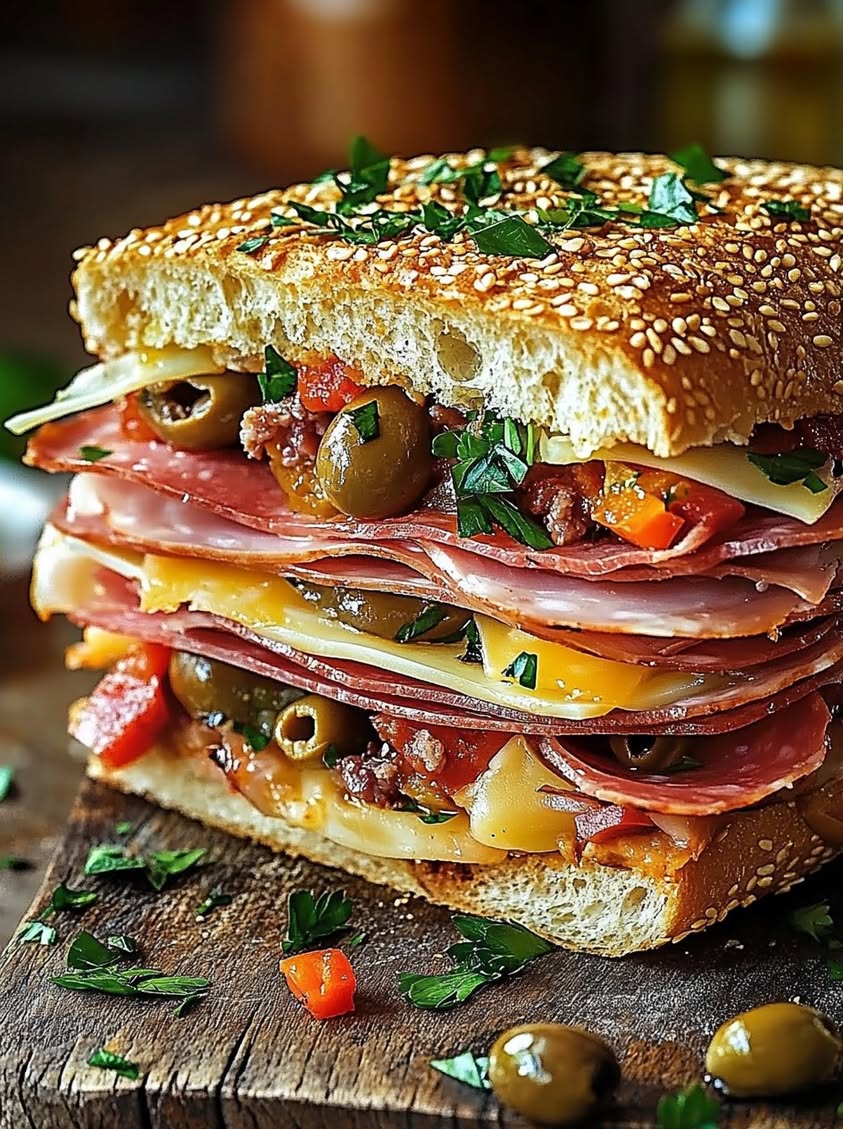
Classic New Orleans–Style Muffuletta: The Ultimate Party Sandwich
Imagine a sandwich so iconic it defines a city’s culinary soul. The Classic New Orleans–Style Muffuletta is that sandwich, a glorious masterpiece of Italian deli meats, provolone cheese, and a vibrant, tangy olive salad, all piled onto a sturdy round loaf. This isn’t just a meal; it’s a portable feast, a taste of history, and the undisputed king of party food. Consequently, every bite delivers a symphony of salty, savory, briny, and creamy flavors that meld together into something truly magical.
Originating in the heart of the French Quarter, this legendary sandwich was born out of necessity for Sicilian immigrant workers. Today, it stands as a symbol of New Orleans’ rich cultural tapestry. Building the perfect muffuletta is an art of balance and patience. The key lies in the olive salad, a zesty condiment that soaks into the bread, transforming it from mere vessel to the star of the show. Ultimately, this recipe brings the spirit of a New Orleans po-boy shop right into your kitchen with minimal effort and maximum reward.
Furthermore, this sandwich is incredibly versatile. You can serve it immediately for a satisfying crunch, or wrap it tightly and let the flavors marry for a few hours, which many purists argue is the only authentic way. Either way, you are guaranteed a show-stopping centerpiece for your next gathering. The Classic New Orleans–Style Muffuletta is more than food; it’s an experience, a conversation starter, and a delicious tribute to one of America’s greatest food cities.
Quick Recipe Highlights
- Flavor Profile: This sandwich boasts a powerful and complex flavor profile. Salty cured meats like mortadella and salami meet the mild creaminess of provolone. Meanwhile, the tangy, garlicky, and briny olive salad cuts through the richness, creating a perfectly balanced bite.
- Texture: The texture journey is exceptional. You start with a slightly crisp exterior of the round loaf, then move to a chewy, olive oil-infused crumb. Next, you encounter the firm slices of meat and cheese, all contrasted by the crunchy vegetables in the salad.
- Aroma: The aroma is unmistakably Italian and incredibly inviting. Initially, you smell the garlic and herbs from the olive salad marinade. Then, the scent of high-quality cured meats and cheese mingles, promising a deeply savory experience.
- Visual Appeal: Visually, it’s a stunning sandwich. The cross-section reveals beautiful layers of pink mortadella, red salami, and white provolone, all generously speckled with the green and red confetti of the olive salad. It’s rustic, hearty, and utterly appetizing.
- Skill Level Needed: This recipe requires absolutely no cooking skill. Essentially, it’s an exercise in assembly. The most challenging part is chopping the vegetables for the salad, making it perfect for novice cooks and seasoned chefs alike.
- Special Equipment: You need almost no special equipment. A good chef’s knife and cutting board for the olive salad are essential. Additionally, a large bowl for mixing and plastic wrap for resting the assembled sandwich are helpful.
Recipe Overview
- Difficulty Level: We rate this recipe as easy because it involves zero cooking techniques. There is no baking, searing, or complex preparation. The process is purely about assembly and patience. Anyone who can use a knife to chop vegetables can successfully create an authentic-tasting muffuletta.
- Category: This sandwich falls squarely into the main dish category. It is incredibly hearty and filling, capable of serving as the entire meal. Furthermore, it fits into the appetizer category when sliced into small wedges for a party, and it’s a premier picnic or game-day food.
- Cuisine: The muffuletta is a cornerstone of New Orleans cuisine, a unique American regional food. Its roots, however, are deeply Sicilian, reflecting the ingredients and flavors brought by Italian immigrants. Therefore, it’s a beautiful fusion of Southern hospitality and Old-World Italian deli traditions.
- Cost: The cost is moderate and depends on the quality of your deli purchases. A round loaf of bread and blocks of cheese are economical. However, sourcing good-quality Italian meats like mortadella and Genoa salami will be the main investment. Overall, it’s cost-effective for the number of servings it yields.
- Season: This is a fantastic year-round sandwich. It shines in spring and summer for picnics and outdoor events because it travels so well. Conversely, it’s equally satisfying in fall and winter as a hearty, no-cook meal that feels indulgent and comforting.
- Occasion: The muffuletta is the ultimate party and gathering food. It’s perfect for game day, Mardi Gras celebrations, potlucks, and family reunions. Moreover, it makes an impressive and easy lunch for a crowd, eliminating the need to cook multiple dishes.
Why You’ll Love This Recipe
First and foremost, you will love the explosive taste and satisfying texture of this Classic New Orleans–Style Muffuletta. Every component plays a crucial role. The savory, fatty meats pair perfectly with the mild, melting provolone. Then, the olive salad delivers a necessary acidic punch and crunch that prevents the sandwich from feeling too heavy. Consequently, each bite is a perfect harmony of salt, fat, acid, and crunch, making it impossibly delicious and deeply craveable.
From a convenience standpoint, this recipe is a true winner. There is no cooking involved, which means no heating up the kitchen. You simply chop, mix, and assemble. This makes it an ideal solution for hot summer days or when you need to feed a crowd without stress. Additionally, you can prepare the olive salad a day or two in advance, allowing the flavors to develop even further and making day-of assembly a breeze.
Nutritionally, while indulgent, this sandwich offers some benefits when made with quality ingredients. Olive oil and olives provide heart-healthy monounsaturated fats. The vegetables in the salad add fiber and vitamins. Choosing leaner cuts of meat, like ham, can adjust the fat content. Ultimately, it’s a balanced package of protein, fat, and complex carbohydrates from the sturdy bread, providing sustained energy.
The social and entertaining value of this sandwich cannot be overstated. It is designed to be shared. Bringing a whole muffuletta to a party is a guaranteed conversation starter. It looks spectacular when cut into wedges, revealing its colorful interior. It serves a lot of people with minimal effort on the host’s part, allowing you to enjoy your own gathering instead of being stuck in the kitchen.
Finally, it is cost-effective and accessible. You do not need rare or expensive ingredients. Most components are found at any well-stocked grocery store deli counter. A single sandwich yields four very generous servings, making it an economical choice for a family meal or party centerpiece. Therefore, you get incredible flavor and impressive presentation without a gourmet price tag.
Historical Background and Cultural Significance
The origin story of the muffuletta is a classic tale of immigrant ingenuity. In the early 1900s, Sicilian farmers and laborers would frequent the Central Grocery in New Orleans’ French Quarter for their lunch. They would buy various components—a round loaf of bread, some salami, ham, cheese, and olive salad—and eat them separately. Legend has it that the shop’s owner, Salvatore Lupo, had the idea to combine them into one massive sandwich for easier handling. Thus, the muffuletta, named after the round “muffuletta” bread used, was born.
Its cultural importance in New Orleans is immense. Alongside po’boys and gumbo, the muffuletta is a pillar of the city’s food identity. It represents the successful integration of Sicilian culinary traditions into the Southern landscape. The Central Grocery still sells its original version today, and it’s a pilgrimage site for food lovers. Consequently, eating a muffuletta is not just eating a sandwich; it’s participating in a living, edible history of New Orleans.
The recipe has evolved modestly since its creation, mostly in the variety of meats used. While the core remains, some modern interpretations might include capicola, soppressata, or even pastrami. The olive salad recipe can also vary from family to family, with some adding giardiniera, celery, or different herb blends. However, the essential architecture—a round loaf, layered meats and cheese, and a wet, tangy olive salad—has remained beautifully constant for over a century.
Regional variations exist, but the New Orleans style is definitive. Outside of Louisiana, you might find muffulettas served on different types of bread or with non-traditional spreads. However, the authentic experience is tied to that specific round, sesame-seeded loaf which is soft enough to absorb the salad’s juices yet sturdy enough to hold the hefty fillings without falling apart. This specific construction is what makes the Classic New Orleans–Style Muffuletta a unique and enduring masterpiece.
Ingredient Deep Dive
Let’s start with the round loaf, often called a muffuletta loaf or a large round Italian bread. This bread is the foundation. It has a crisp crust and a soft, airy interior that’s perfect for absorbing the olive oil and vinegar from the salad without becoming soggy mush. If you cannot find a specific muffuletta loaf, a large round ciabatta or a sturdy Italian bread loaf are the best substitutes. Avoid bread that is too dense or too soft.
The olive salad is the soul of the sandwich. A traditional mix includes green and black olives, chopped celery, cauliflower, carrots, garlic, oregano, and pickled vegetables, all marinated in olive oil and vinegar. This condiment originated as a way to preserve vegetables. Its briny, tangy flavor cuts the fat of the meats and adds essential moisture and crunch. You can find pre-made versions, but homemade is vastly superior in flavor and texture.
Mortadella is a crucial Italian cold cut. This finely emulsified pork sausage is studded with cubes of fat and often pistachios. It has a delicate, mild flavor and a soft, almost creamy texture that contrasts beautifully with firmer meats. Its history dates back to Roman times. For the best quality, look for mortadella from a deli counter rather than pre-packaged. If unavailable, a good-quality ham is an acceptable substitute, though the texture will be different.
Genoa salami provides a firmer, more peppery bite. This dry-cured sausage from the Genoa region of Italy is made from pork and seasoned with garlic and red wine. It adds a necessary chew and robust flavor. Similarly, ham offers a leaner, sweeter saltiness that balances the richer meats. Always opt for thinly sliced meats from the deli counter for the best texture and flavor layering in your Classic New Orleans–Style Muffuletta.
Provolone cheese acts as the creamy, melty glue that holds the layers together. Mild provolone is traditional, offering a buttery flavor without overpowering the meats. Its semi-soft texture allows it to meld with the other ingredients as the sandwich rests. For a sharper bite, you could use aged provolone. Avoid pre-sliced packaged cheese if possible; instead, ask your deli to slice it thinly from a block for better quality and melt.
Common Mistakes to Avoid
- Using the wrong bread. A flimsy or pre-sliced sandwich loaf will collapse under the weight and moisture. You must use a sturdy, round loaf with a crisp crust to achieve the proper texture and structural integrity.
- Skipping the resting time. Assembling and eating the sandwich immediately is a common error. The muffuletta needs time to rest, wrapped tightly, so the olive salad juices can permeate the bread. This step transforms it from separate ingredients into a cohesive, flavorful unit.
- Overloading or underloading the sandwich. Too little filling makes it bland; too much makes it impossible to eat. Follow the layered approach, ensuring even coverage of meats, cheese, and salad across the entire surface of the bread.
- Not draining the olive salad. If your homemade or store-bought salad is swimming in liquid, drain some off before adding. You want the bread to be moistened, not soaked and disintegrated.
- Cutting the sandwich incorrectly. Always slice the muffuletta into wedges, like a pie. Cutting it into rectangles or squares disrupts the layering and makes for messy, uneven servings.
- Using low-quality, pre-packaged meats and cheese. The flavor of this sandwich depends entirely on the quality of its components. Invest in good deli-sliced meats and cheese from the counter for a significantly better result.
- Neglecting the garlic. The garlic in the olive salad marinade is non-negotiable. It infuses the oil and ties all the other flavors together. Do not omit it or use garlic powder as a substitute.
- Forgetting to hollow out the top bread half. Removing some of the soft interior crumb from the top creates a shallow well for the olive salad. This helps contain it and ensures every bite has the perfect ratio of bread to filling.
Essential Techniques
The first essential technique is preparing the olive salad. This is not just chopping; it’s about achieving a uniform, small dice. Consistent pieces ensure every scoop of salad has a bit of every flavor and texture. You want the vegetables and olives to be in small enough pieces to distribute evenly but not so small that they become a paste. Mix the salad well with the oil and vinegar and let it sit for at least 30 minutes to allow the flavors to marry before assembling the sandwich.
Next is the bread preparation. Carefully slice the entire round loaf in half horizontally. Then, using your fingers, gently pull out some of the soft interior crumb from both the top and bottom halves. This creates more room for the fillings and prevents the sandwich from being too bready. Importantly, it also allows the bread to better absorb the delicious juices from the olive salad, which is key to the sandwich’s signature texture.
Layering is a critical technique. You must build the sandwich in a specific order for optimal flavor distribution and structural stability. Start by spreading a generous layer of olive salad on the bottom half of the bread. Then, layer the meats and cheese evenly, alternating types. Finish with another thick layer of olive salad on the top half. This method ensures every bite, from top to bottom, contains the tangy, briny element that defines the Classic New Orleans–Style Muffuletta.
The final and most crucial technique is the resting period. After assembly, wrap the entire sandwich very tightly in plastic wrap. Then, place a heavy skillet or a few cans on top to lightly press it. Let it rest at room temperature for at least an hour, or in the refrigerator for up to 24 hours. This pressing allows the flavors to meld and the juices to soak into the bread, transforming the separate components into one unified, incredible sandwich.
Pro Tips for Perfect Classic New Orleans–Style Muffuletta
Make your olive salad a day ahead. This gives the vegetables time to pickle slightly in the vinegar and oil, and for the garlic and herb flavors to fully infuse the entire mixture. The difference in depth of flavor is remarkable.
Warm the sandwich slightly before serving if it has been refrigerated. A 10-minute stint in a 300°F oven or a few minutes pressed in a panini press (without squishing it flat) will revive the bread’s texture and gently melt the cheese.
Use a serrated bread knife for slicing. A sharp serrated knife will cleanly cut through the crust and all the layers without tearing the bread or dragging the fillings out.
Drizzle a little extra virgin olive oil on the cut sides of the bread before adding the olive salad. This adds another layer of flavor and ensures the bread stays tender.
If serving at a party, pre-slice the muffuletta into wedges but leave them nestled together. This makes it easy for guests to grab a piece while maintaining the sandwich’s impressive presentation.
Add a layer of mild lettuce, like butter lettuce, between the bottom bread and the first layer of olive salad. This creates a slight barrier that can help prevent sogginess if you plan to let the sandwich rest for many hours.
Experiment with different olives in your salad. Using a mix of Castelvetrano, Kalamata, and green olives with pimentos can create a more complex flavor profile.
Always bring the sandwich to room temperature for about 30 minutes before serving if it has been pressed in the fridge. This allows the fats in the meat and cheese to soften, maximizing flavor and texture.
Variations and Adaptations
For regional variations, some New Orleans shops use a specific olive salad mix that includes giardiniera. Others might add a smear of mustard or mayonnaise, though purists would argue against it. In other parts of the country, you might see it served on a long roll or even as a hot pressed sandwich.
Seasonal adaptations are easy with the olive salad. In summer, add fresh, chopped herbs like basil or parsley. In winter, incorporate roasted red peppers or artichoke hearts for a heartier feel. The core recipe remains wonderfully adaptable to what’s fresh and available.
Dietary modifications are straightforward. For a gluten-free version, use a sturdy gluten-free round loaf. For a lower-carb option, serve the fillings as a salad on a bed of lettuce, using the olive salad as the dressing. A vegetarian muffuletta can be made with grilled portobello mushrooms, roasted peppers, and marinated artichokes in place of the meats.
Flavor variations can include swapping provolone for Swiss or mozzarella. Add a layer of spicy capicola or soppressata for a kick. Incorporate a thin spread of spicy brown mustard or a layer of roasted garlic aioli for an extra flavor dimension.
Texture modifications might involve toasting the bread lightly before assembly for extra crunch. Alternatively, you could chop the meats and cheese more roughly for a “chopped muffuletta” salad approach, mixing everything with the olive salad and serving it with crackers.
Presentation alternatives include making individual muffuletta sliders on small round rolls for a party. You can also deconstruct the sandwich into a charcuterie board, serving the bread, meats, cheese, and olive salad separately for guests to build their own bites.
Serving and Presentation Guide
Plating techniques are simple but effective. Place the whole, uncut muffuletta on a large wooden cutting board or a rustic platter. Have a sharp serrated knife alongside. This creates an inviting, family-style presentation that encourages sharing. For individual plates, place a wedge on the plate with a small pile of potato chips or a pickle spear tucked alongside.
Garnishing ideas should be minimal to let the sandwich shine. A few whole olives or pepperoncini on the platter add color. A light sprinkle of fresh chopped parsley or oregano over the top after cutting can add a fresh aroma. Avoid wet garnishes that could make the bread soggy.
Traditional accompaniments are simple. Classic New Orleans–Style Muffuletta is often served with a side of Zapp’s potato chips and a cold Barq’s root beer or an Abita beer. A simple dill pickle spear is also a classic and palate-cleansing side.
Modern serving suggestions might include a side of creamy coleslaw or a light, vinegary pasta salad. For a fancier touch, serve with a small cup of gumbo or red beans and rice on the side, embracing the full New Orleans experience.
Temperature considerations are key. The sandwich is best served at cool room temperature. If refrigerated, let it sit out for 30 minutes before serving. If you prefer it warm, heat it gently as described in the pro tips to avoid melting the salad ingredients or making the bread tough.
Portion control tips are built into the design. One standard muffuletta cleanly yields four substantial wedges. For a party with other food, you can cut it into eight smaller wedges for a hearty appetizer portion. It’s rich and filling, so a little goes a long way.
Wine and Beverage Pairing
Wine pairings should complement the salty, savory, and tangy flavors. A dry Italian red like Chianti or Barbera works beautifully, as their acidity cuts through the fat. A crisp, dry rosé is another excellent choice, especially for a warm-weather picnic. For white wine lovers, a Pinot Grigio or a Vermentino with good acidity can balance the briny olive salad.
Non-alcoholic alternatives are plentiful. Iced tea, either sweetened Southern-style or unsweetened with lemon, is a classic and refreshing choice. Sparkling water with a squeeze of citrus cleanses the palate. A tart lemonade or a ginger beer also stands up well to the robust flavors of the sandwich.
Coffee and tea pairings work well if serving the muffuletta for lunch. A strong, dark roast coffee complements the garlic and savory notes. A glass of cold brew coffee is particularly refreshing. For tea, a robust black tea like English Breakfast or an iced herbal tea with mint would be suitable.
Temperature considerations for beverages are straightforward. Cold, crisp drinks are generally best to contrast the rich, room-temperature sandwich. Iced beverages, chilled wines, and cold beers will provide the most satisfying contrast and refreshment.
Serving suggestions include offering a variety of drinks to suit all guests. Set out a cooler with assorted beers, a bottle of red and white wine, and a large pitcher of iced tea or lemonade. This ensures everyone can find their perfect pairing for this iconic Classic New Orleans–Style Muffuletta.
Storage and Shelf Life
Storage methods are crucial for food safety and quality. A fully assembled muffuletta can be wrapped tightly in plastic wrap and stored in the refrigerator for up to 24 hours. For longer storage, wrap individual wedges tightly and refrigerate for up to 2 days. The olive salad alone can be stored in an airtight container in the fridge for up to one week.
Temperature requirements are simple: always refrigerate if not consuming within 2 hours of assembly. The sandwich contains perishable cured meats and dairy. Do not leave it at room temperature for extended periods, especially in warm weather.
Container recommendations include using an airtight container for the whole sandwich or individual pieces. If using plastic wrap, ensure it is very tight to prevent the bread from drying out in the fridge. You can also store it in a large zip-top bag with the air pressed out.
Signs of spoilage include a sour smell, slimy texture on the meats or vegetables, or visible mold on the bread. If the olive salad develops an off odor or the vegetables become excessively soft and mushy, it’s time to discard it.
Reheating instructions are optional. If you prefer it warm, place a wedge on a baking sheet in a 300°F oven for 5-10 minutes, just until the cheese is slightly melted and the bread is warmed through. Avoid the microwave, as it will make the bread rubbery and can overheat the salad.
Freezing guidelines are not generally recommended for the fully assembled sandwich, as the texture of the bread and vegetables will suffer upon thawing. However, you can freeze the olive salad in an airtight container for up to 2 months. Thaw in the refrigerator before using.
Make Ahead Strategies
Prep timeline is very flexible. The olive salad can and should be made 1-2 days ahead. The bread can be purchased the day before. The meats and cheese can be sliced and stored separately in the deli paper in the fridge. On the day of serving, assembly takes just 10 minutes, followed by a 1-hour rest at minimum.
Storage between steps is simple. Keep the olive salad in a jar or container in the fridge. Keep the sliced meats and cheese in their deli paper, placed inside a zip-top bag in the fridge. Store the bread at room temperature in its bag until ready to assemble.
Quality impact assessment is positive. Making components ahead actually improves the final product. The olive salad’s flavor deepens. The meats and cheese being cold makes them easier to handle and layer neatly. The only element that suffers from being made too far ahead is the assembled sandwich resting for more than 24 hours, as the bread can become overly soft.
Assembly tips for make-ahead: Assemble the entire sandwich, wrap it tightly in plastic wrap, and refrigerate it. You can do this the night before your event. The pressing time happens in the fridge. This is the ultimate make-ahead strategy for stress-free entertaining.
Reheating guidelines for a make-ahead sandwich are the same. If you’ve refrigerated it for over 12 hours, let it sit at room temperature for 30 minutes, then optionally warm it gently in the oven to refresh the bread’s texture before slicing and serving.
Fresh element additions are not typically needed, as everything is preserved or cured. However, if you want a burst of freshness, you can add a few leaves of fresh basil or arugula to individual wedges just before serving, after the sandwich has been sliced.
Scaling Instructions
Halving the recipe is easy. Use a smaller round loaf or a large ciabatta roll. Simply reduce all other ingredients by half. The assembly and resting process remains identical. This is perfect for a lunch for two with minimal leftovers.
Doubling or tripling is ideal for a large party. You will need multiple round loaves. Prepare a large batch of olive salad in a big bowl. Set up an assembly line to layer each sandwich. Wrap and press each one individually. This allows you to create a stunning sandwich platter that will feed a crowd.
Equipment adjustments for scaling up are minimal. You’ll need a larger mixing bowl for the olive salad and more plastic wrap. Ensure you have enough space in your refrigerator to store the pressed sandwiches flat, possibly on baking sheets.
Timing modifications are not necessary. Whether making one sandwich or six, the prep time per sandwich remains about 20 minutes of active work. The resting time is constant at a minimum of one hour, regardless of quantity.
Storage considerations for multiple sandwiches: If making several ahead of time, label them with the date assembled. Store them stacked carefully in the fridge, but avoid placing heavy items on top that could squish them flat. They can be refrigerated for up to 24 hours before serving.
Nutritional Deep Dive
Macro breakdown for a typical wedge is substantial. It is rich in protein from the meats and cheese, providing long-lasting energy. The fats come from the olive oil, olives, and meats, including both saturated and heart-healthy monounsaturated fats. Carbohydrates are primarily from the bread, offering fuel and fiber, especially if using a whole-grain or seeded loaf.
Micronutrient analysis reveals benefits from the olive salad components. Olives and olive oil provide vitamin E and antioxidants. The vegetables like celery and carrots offer vitamins A, C, and K, along with potassium. Garlic contributes allicin, a compound with noted health benefits.
Health benefits are tied to its Mediterranean-inspired ingredients. The olive oil is a cornerstone of the heart-healthy Mediterranean diet. The vegetables add fiber for digestive health. The protein supports muscle maintenance. Enjoyed in moderation as part of a balanced diet, it can be a wholesome, satisfying meal.
Dietary considerations are important to note. This sandwich is not suitable for gluten-free, low-sodium, or vegetarian diets in its classic form. However, as discussed, it can be adapted. It is also high in sodium due to the cured meats, olives, and pickled vegetables, so those monitoring sodium intake should be mindful of portion size.
Portion analysis shows one wedge is a complete, filling meal. Due to its density and richness, it’s easy to feel satisfied with one portion. Pairing it with a light side salad instead of chips can create a more balanced plate if desired.
Weight management tips include being mindful of the portion size—one wedge is plenty. You can also use leaner ham as the primary meat, increase the vegetable content in the olive salad, and use a lighter hand with the cheese to reduce overall calories without sacrificing the essential experience of the Classic New Orleans–Style Muffuletta.
Dietary Adaptations
For a gluten-free adaptation, source a sturdy, round gluten-free bread loaf. Many bakeries now offer them. Ensure your olive salad ingredients and deli meats are certified gluten-free, as some may contain gluten-based fillers or be processed on shared equipment.
A dairy-free version is simple: omit the provolone cheese. The sandwich will still be delicious with just the meats and olive salad. For creaminess, you could add a layer of dairy-free pesto or a slice of ripe avocado.
Creating a vegan muffuletta requires more creativity. Replace the meats with grilled or marinated vegetables like eggplant, zucchini, and portobello mushrooms. Use a vegan cheese substitute or skip it altogether. The olive salad remains the star, providing the signature flavor.
Low-carb and keto adaptations involve ditching the bread. Serve the meats, cheese, and olive salad as a large, composed salad on a bed of greens. You can also use the fillings to stuff large portobello mushroom caps or bell peppers.
For a paleo version, use grain-free bread or lettuce wraps. Ensure the meats are sugar-free and uncured, and that the olive salad is made with approved ingredients, avoiding any processed vegetable oils or non-paleo additives.
A low-FODMAP adaptation requires careful ingredient selection. Use a gluten-free, sourdough bread if tolerated. In the olive salad, use only the green parts of scallions instead of garlic, and ensure the vegetables are low-FODMAP like carrots and green olives. Choose meats without garlic or onion additives.
Troubleshooting Guide
If the bread becomes too soggy, you likely used an olive salad with too much liquid or didn’t drain it enough. Next time, drain the salad in a colander before using. Also, ensure you hollowed out enough bread to create a buffer. For salvage, you can carefully scrape off excess wet salad and eat the sandwich with a fork and knife.
If the flavors seem bland, the issue is likely underseasoned olive salad or poor-quality meats. Always taste your olive salad before assembling and adjust with more salt, pepper, vinegar, or herbs. Invest in good deli meats. You can also add a very light sprinkle of salt and a drizzle of high-quality olive oil to the cut sides of the bread before building.
If the sandwich is too difficult to bite through, the bread may be too crusty or the layers too thick. Briefly warming the whole loaf before slicing and assembling can soften the crust. Also, ensure your meats and cheese are sliced paper-thin, not thick-cut.
If the olive salad tastes too sharp or vinegary, it may not have had enough time to mellow. Making it a day ahead solves this. To fix an already-assembled sandwich, balance it by adding a thin spread of cream cheese or butter to the bread to add a creamy, fatty element that counters the acid.
If you lack a round loaf, a large, wide Italian loaf or a focaccia square are the best substitutes. Cut it to a size that mimics a round shape as much as possible. The key is a sturdy crust and a soft interior that can absorb moisture without falling apart.
If timing is a concern and you can’t let it rest for an hour, even 30 minutes wrapped at room temperature is better than nothing. The pressing is more important than the length of time. Use a heavy pot to weigh it down during that shorter period to help the layers compact and the juices begin to soak in.
Recipe Success Stories
Community feedback on this Classic New Orleans–Style Muffuletta recipe consistently highlights its crowd-pleasing nature. Many readers report it becoming the star of their Super Bowl or Mardi Gras parties. Families love it for a easy, no-cook weekend dinner that everyone can customize by adding more or less olive salad to their wedge.
Variation successes are fun to hear about. One reader added hot pepper relish to their olive salad for a spicy kick. Another used a combination of mortadella, soppressata, and prosciutto for an ultra-authentic Italian feel. A creative cook even made mini muffuletta sliders for a wedding shower, which were a huge hit.
Adaptation stories from those with dietary restrictions are inspiring. A gluten-free follower found a perfect round loaf at a local bakery and said it was the first time her family could all share the same sandwich. A vegetarian reader raved about the version with grilled vegetables, claiming even the meat-eaters at her table loved it.
Reader suggestions have improved the recipe over time. One great tip was to add a splash of the olive salad marinade to the hollowed-out bread before adding the fillings for extra flavor penetration. Another suggested serving it with a side of spicy Creole mustard for dipping.
Photography tips from successful makers include slicing the sandwich with a very sharp knife for a clean cross-section. They recommend photographing it on a rustic board with the remaining olive salad in a jar nearby. Natural light is key to capturing the beautiful colors of the meats and the glossy sheen of the olive salad.
Frequently Asked Questions
Q: Can I make a muffuletta without a round loaf?
A: Absolutely. While a round loaf is traditional, a wide Italian loaf or a large ciabatta works well. The key is sturdy bread with a good crust that can hold the fillings and absorb moisture without disintegrating. Just shape your sandwich accordingly.
Q: How long does a muffuletta keep?
A: An assembled muffuletta is best within 24 hours. After that, the bread can become overly soft. The olive salad alone keeps for up to a week in an airtight container in the refrigerator. I do not recommend freezing the assembled sandwich.
Q: Is it necessary to press the sandwich?
I’m Shaykee—born in Morocco, seasoned across continents. From airplane galleys to home kitchens, I share the flavors and stories that shaped my journey.